

Yoga includes many postures, from gentle resting poses to challenging balances and inversions. Some familiar poses can still be confusing when their names or instructions are unclear. This guide explains ten common yoga poses with simple steps and practical modifications.
Move slowly and choose a version that feels comfortable. You do not need to reach the fullest expression of a pose. If you feel sharp pain, dizziness, numbness or unusual discomfort, stop and rest.
Before You Begin
Practise on a stable, nonslip surface with enough room to move. A yoga mat can provide cushioning, and a folded blanket, block or sturdy chair may help you feel supported.
If you are new to yoga, recovering from an injury or have a health condition, ask a qualified yoga teacher or healthcare professional about suitable modifications. Avoid attempting advanced inversions such as Headstand without proper preparation and direct instruction.
1. Camel Pose
Camel Pose, or Ustrasana, is a kneeling backbend. It can be practised with your hands on your hips or lower back. Reaching for your heels is optional.
- Kneel with your knees about hip-width apart and the tops of your feet resting on the mat.
- Place your hands on your hips or lower back.
- Gently lengthen through your spine and lift your chest.
- If comfortable, move your hands toward your heels one at a time. Keep your hips above your knees.
- Let your head remain in a comfortable position. Do not drop it back if that strains your neck.
- To come out, bring your hands back to your hips and slowly return to an upright kneeling position.
Keep the movement small if you are new to backbends. You can stay upright with your hands supporting your lower back.
2. Child’s Pose
Child’s Pose, or Balasana, is a kneeling resting position. Use a cushion or bolster if your hips, knees or forehead need support.
- Kneel on the mat and bring your big toes together.
- Separate your knees to a comfortable width.
- Slowly move your hips back toward your heels.
- Rest your chest over your thighs or on a cushion placed in front of you.
- Rest your forehead on the mat, a folded blanket or a block.
- Let your arms rest beside you or reach them forward without straining.
If kneeling is uncomfortable, sit on a chair and lean your forearms on a cushion placed on your lap. For more detailed guidance, see our Child’s Pose step-by-step guide.

3. Cat-Cow Pose
Cat-Cow is a gentle movement between spinal extension and flexion. It is usually practised on hands and knees.
- Begin on your hands and knees, with your hands under your shoulders and knees under your hips.
- As you breathe in, gently lift your chest and tailbone. Keep the movement comfortable.
- As you breathe out, press the floor away and round your upper back.
- Move slowly between the two positions for a few rounds.
- Return to a neutral spine and rest.
Avoid forcing your head or lower back. If your wrists are uncomfortable, try the movement seated with your hands on your thighs.

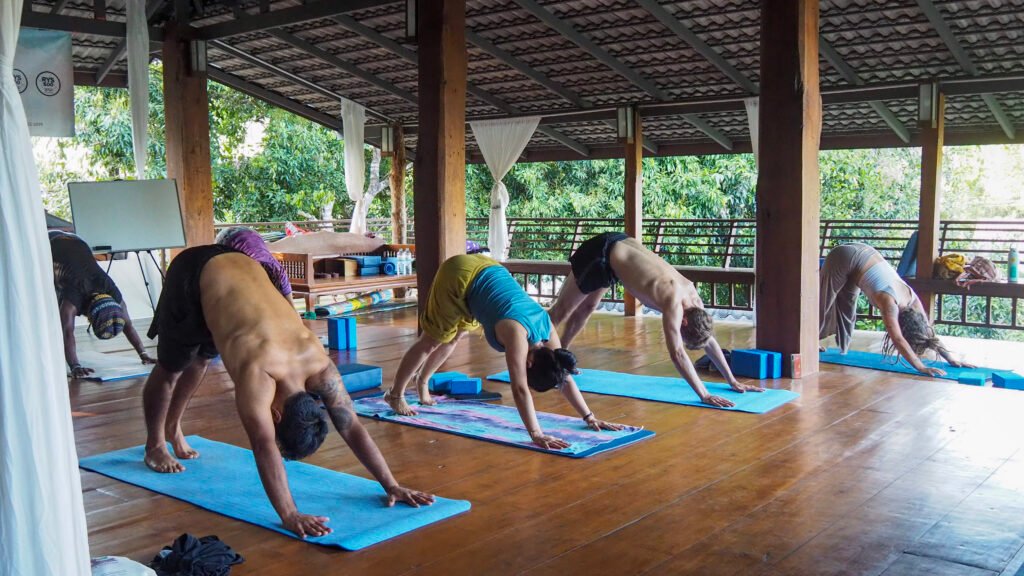
4. Downward-Facing Dog
Downward-Facing Dog, or Adho Mukha Svanasana, begins on hands and knees. It is not necessary to straighten your legs or place your heels on the floor.
- Begin on your hands and knees, with your hands slightly forward of your shoulders.
- Spread your fingers and press gently through your palms.
- Tuck your toes and slowly lift your hips up and back.
- Bend your knees as needed and keep your spine long.
- Let your head rest between your upper arms without forcing your neck.
- To come out, lower your knees to the mat.
If the pose strains your wrists or shoulders, shorten the hold or try placing your hands on a sturdy chair or wall.
5. Warrior II
Warrior II, or Virabhadrasana II, is one of several Warrior variations. It is a standing pose with the feet apart and arms extended to the sides.
- Stand with your feet wide apart.
- Turn your right foot outward and angle your left foot slightly inward.
- Bend your right knee, keeping it directed toward your toes.
- Extend your arms to the sides at a comfortable height.
- Keep your torso upright and look over your right hand if your neck feels comfortable.
- Straighten your right leg and turn your feet to practise on the other side.
Use a shorter stance or bend the front knee less if that feels more stable. Keep breathing and avoid forcing the knee bend.

6. Side Plank Pose
Side Plank, or Vasisthasana, is a balancing pose that supports the body on one hand and the outer edge of one foot. A lower-knee variation can make it more accessible.
- Begin in a high plank with your hands under your shoulders.
- Shift your weight into your right hand.
- Turn your body to the left and place your left foot on top of your right, or stagger your feet for more stability.
- Lift your left arm toward the ceiling only if your balance feels steady.
- Keep your body in a comfortable line and breathe naturally.
- Lower your hand and return to plank, then practise on the other side.
For a gentler version, keep your lower knee on the mat. Stop if your wrist or shoulder feels strained.
7. Upward-Facing Dog
Upward-Facing Dog, or Urdhva Mukha Svanasana, is a backbend that begins lying face down. It is different from Downward-Facing Dog and from Cobra Pose.
- Lie on your stomach with your legs extended behind you.
- Place your hands beside your lower ribs, with your elbows bent.
- Press through your hands and lift your chest.
- If comfortable, lift your thighs and knees from the mat while pressing the tops of your feet down.
- Keep your shoulders away from your ears and look forward without compressing your neck.
- Bend your elbows and lower down with control.
This pose may be too strong for some beginners. Practise Cobra Pose instead if you need a gentler backbend.

8. Cobra Pose
Cobra Pose, or Bhujangasana, is a backbend practised lying face down. Keep your pelvis and lower body on the mat and lift only as high as feels comfortable.
- Lie on your stomach with your legs extended behind you.
- Place your hands under or slightly ahead of your shoulders.
- Keep your elbows close to your sides.
- Press lightly through your hands and lift your chest a small amount.
- Keep your lower ribs and pelvis grounded. Avoid pushing hard through your arms.
- Slowly lower your chest to the mat.
You can keep your hands slightly forward and lift less if your lower back feels compressed. For more detailed guidance, see our Cobra Pose step-by-step guide.
9. Tree Pose
Tree Pose, or Vrksasana, is a standing balance. Place your lifted foot against your ankle, calf or inner thigh. Avoid pressing it directly into the side of your knee.
- Stand tall with both feet on the mat.
- Shift your weight onto your left foot and keep a soft bend in that knee.
- Place the sole of your right foot against your left ankle, calf or inner thigh.
- Bring your hands together at your chest or hold a wall or chair for support.
- Keep your gaze on a steady point and breathe naturally.
- Lower your foot and repeat on the other side.
Use a wall for balance and keep your toes on the floor if lifting the foot feels unsteady.
10. Headstand Pose
Headstand, or Sirsasana, is an advanced inversion. It places significant demands on balance, the shoulders and the neck. It is not a suitable pose to learn from written instructions alone.
If you are interested in Headstand, learn the preparation and alignment from a qualified yoga teacher who can supervise you directly. Do not place your full body weight on your head or neck, and do not attempt the pose if you are not properly prepared. Beginners can choose a non-inverted alternative, such as Legs Up the Wall, if that position is appropriate for them.
Common Yoga Practice Mistakes
- Trying to copy the final shape: Use the version that lets you breathe and stay in control.
- Forcing a stretch: A stronger sensation is not necessarily a better pose.
- Holding your breath: Ease out if you cannot breathe comfortably.
- Ignoring pain: Stop if you feel sharp, pinching or unusual pain.
- Treating all pose names as universal: Some pose names and variations differ between yoga traditions and teachers.
- Attempting advanced poses without guidance: Learn inversions and demanding arm balances with an appropriately qualified instructor.
Frequently Asked Questions
Are these yoga poses suitable for beginners?
Several poses in this guide have beginner-friendly options, including Child’s Pose, Cat-Cow, Downward-Facing Dog and Tree Pose with support. Headstand is advanced and should not be attempted without direct instruction.
Do I need to be flexible to practise yoga?
No. You can begin with comfortable movements and use modifications. Flexibility is not a requirement for starting yoga.
What is the difference between Cobra Pose and Upward-Facing Dog?
Both are backbends practised face down, but they differ in setup and how much of the body lifts. In Cobra Pose, the pelvis and lower body stay on the mat. In Upward-Facing Dog, the chest and thighs lift while the tops of the feet press into the floor.
What should I do if a pose hurts?
Stop the pose and rest. Do not push through sharp or unusual pain. A qualified yoga teacher or healthcare professional can help you decide whether a modification is appropriate.
Conclusion
Yoga poses should be practised with attention to alignment, comfort and personal ability. This guide covers ten familiar poses, including standing postures, floor poses and an advanced inversion.
Begin with the poses and variations that feel manageable. Use support when needed, keep breathing naturally and learn challenging postures from a qualified teacher.
If you prefer a few quiet moments before getting up, gentle movement in bed can help you ease into your morning. These five stretches are simple options to try while lying on a stable mattress. Move slowly and keep each stretch within a comfortable range.
These movements are not a medical treatment, and you do not need to do all five. If any movement causes pain, dizziness, numbness or unusual discomfort, stop and return to a comfortable position.
Before You Begin
Stay lying down and move gently at first. A very soft or unstable mattress may make some movements harder, so keep your body supported and avoid reaching beyond a comfortable range.
If you have an injury, a health condition or ongoing pain, ask a healthcare professional whether these stretches are suitable for you. Move slowly when you are ready to sit up or get out of bed.
1. Full-Body Stretch
This gentle movement lets you reach through your arms and legs while staying on your back.
- Lie on your back with your head supported by a pillow if comfortable.
- Reach both arms overhead along the bed.
- Lengthen your legs and gently reach your heels away from your hips.
- Keep your shoulders relaxed and avoid arching your lower back.
- Take a few natural breaths, then release your arms and legs.
You can stretch your arms and legs separately if reaching in both directions feels uncomfortable.
2. One-Knee-to-Chest Stretch
This stretch brings one bent leg toward your body. Keep the other leg in whichever position feels comfortable.
- Lie on your back with both legs relaxed.
- Bend your right knee and gently bring it toward your chest.
- Hold behind your thigh or around your shin. Avoid pressing directly on the knee.
- Keep your shoulders and head resting comfortably.
- Take a few natural breaths, then lower the leg slowly.
- Repeat on the left side.
You do not need to pull your knee close to your chest. Stop at the first comfortable stretch.
3. Gentle Supine Knee Roll
This small movement lets your bent knees travel slightly from side to side.
- Lie on your back and bend your knees, keeping your feet on the mattress.
- Let both arms rest beside you.
- Slowly move your knees a short distance to the right.
- Keep your shoulders comfortable and breathe naturally.
- Bring your knees back to the centre, then move them a short distance to the left.
Keep the movement small. If your back or hips feel uncomfortable, return to the centre and stop.
4. Lying Hamstring Stretch
This stretch targets the back of one thigh. You can hold your leg behind the thigh or use a towel if one is within easy reach.
- Lie on your back with both knees bent.
- Keep your left foot on the mattress and lift your right leg toward the ceiling.
- Hold behind your thigh, keeping a slight bend in your knee.
- Gently bring the leg toward you until you feel a comfortable stretch.
- Keep your head and shoulders relaxed.
- Lower the leg slowly, then repeat on the other side.
Do not lock your knee or pull hard on your leg. If you cannot hold comfortably, keep the knee more bent.
5. Ankle Pumps and Circles
This simple movement brings attention to your ankles and feet before you stand.
- Lie on your back with your legs supported.
- Point both feet gently away from you.
- Bring your toes back toward your shins.
- Repeat the movement at a comfortable pace.
- Make a few small circles with each ankle in one direction, then the other.
Keep the movement easy and stop if it causes pain, cramping or unusual sensations.
A Simple Morning Sequence
You can try these movements in order:
- Full-Body Stretch
- One-Knee-to-Chest Stretch on each side
- Gentle Supine Knee Roll
- Lying Hamstring Stretch on each side
- Ankle Pumps and Circles
Move at your own pace. There is no required number of repetitions or fixed time. Leave out any stretch that does not feel comfortable. When you finish, roll onto your side and use your arms to help you sit up slowly.
If you are ready to get out of bed and want a fuller routine, try our beginner-friendly morning yoga routine.
Tips for Comfortable Morning Stretching
- Start with small movements and give yourself time to wake up.
- Keep breathing naturally instead of holding your breath.
- Support your head with a pillow if that feels comfortable.
- Do not bounce or force a stretch.
- Change your position if a movement feels awkward.
- Stop if you feel pain, dizziness, numbness or unusual discomfort.
- Sit up slowly before standing, especially if you feel lightheaded.
Frequently Asked Questions
Can I stretch before getting out of bed?
Many people choose to do gentle movements while lying down. Keep them comfortable, move slowly and stop if anything causes pain or unusual symptoms.
How long should I hold each stretch?
There is no fixed time that works for everyone. Take a few comfortable breaths in each position, then release. Do not stay in a stretch if it feels uncomfortable.
Do these stretches need yoga equipment?
No equipment is required. A pillow can support your head, and a towel can help with the hamstring stretch if you already have one nearby.
Will these stretches guarantee more energy?
No stretch can guarantee a particular effect. These movements simply offer a gentle way to start moving before you get out of bed. Your experience may vary.
What if I have pain or an injury?
Skip any movement that causes pain. Ask a healthcare professional for personalised guidance if you have an injury, a health condition or persistent symptoms.
Conclusion
A few gentle movements in bed can provide an easy transition from resting to getting up. Try the five stretches one at a time, keep the range comfortable and choose only the movements that suit you.
Move slowly, breathe naturally and stop if you feel pain or unusual discomfort. A short, simple start is enough.
After a long day at a desk or in a chair, you may want to move your hips, back and shoulders through a comfortable range of motion. A short yoga practice can give you a structured way to do that.
These nine yoga poses after sitting all day include gentle movement, hip stretches, a chest opener and supported floor poses. Move slowly and use the easier options whenever they feel more comfortable. The aim is to notice a mild stretch or comfortable movement, not to force your body into a deep pose.
Before You Begin
Choose a stable, non-slip surface with enough room to move. Wear comfortable clothing and keep a chair or wall nearby for support if you need it.
Start with a few gentle movements rather than trying to stretch as deeply as possible. Breathe normally. If a movement causes sharp pain, numbness, tingling or increasing discomfort, stop and return to a comfortable position.
1. Cat-Cow Pose (Marjaryasana-Bitilasana)
Cat-Cow gently moves the spine between a rounded and extended position. Keep the movement small and comfortable.
How to practise
- Come onto your hands and knees. Place your hands under your shoulders and your knees under your hips.
- Spread your fingers and let your head stay in line with your spine.
- As you breathe in, gently tip your sitting bones upward, move your chest forward and let your back form a soft arch.
- As you breathe out, press the floor away, round your back and let your head follow the movement without pulling your chin forcefully to your chest.
- Continue slowly for several comfortable rounds.
Easier option
If kneeling is uncomfortable, sit on a stable chair. Rest your hands on your thighs and gently alternate between lifting your chest and rounding your upper back.
2. Standing Chest Opener
A gentle chest opener can move your shoulders after a day of reaching toward a keyboard or screen. Keep the range of motion easy.
How to practise
- Stand with your feet about hip-width apart and your knees relaxed.
- Rest your hands on your hips, or gently bring your arms behind you and hold one wrist with the opposite hand.
- Draw your shoulders slightly back and down without forcing them.
- Lift through the centre of your chest while keeping your ribs relaxed.
- Stay for a few easy breaths, then release your arms.
Easier option
Keep your hands on your hips and simply widen across your collarbones. Do not pull your shoulders back hard.
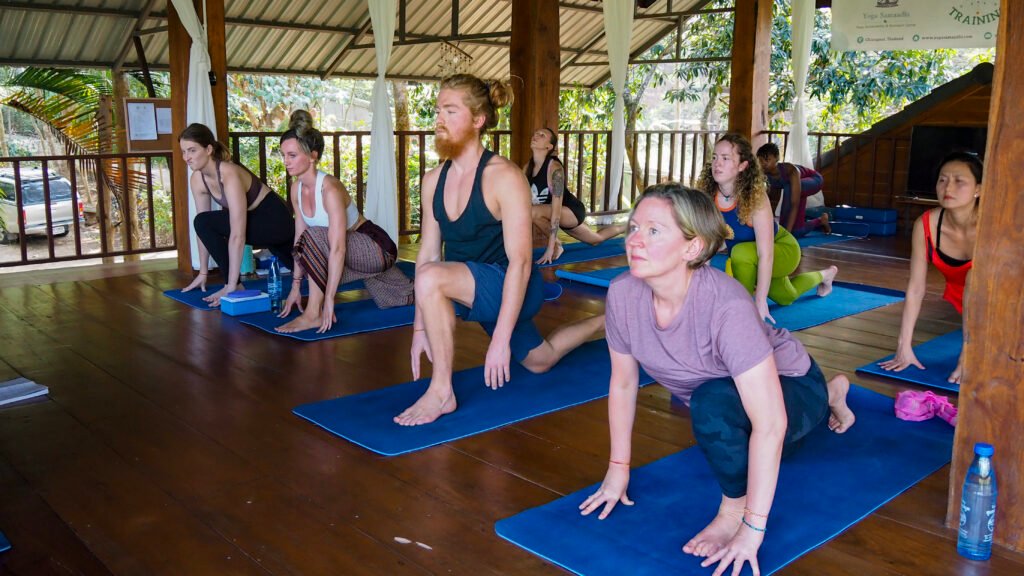
3. Low Lunge (Anjaneyasana)
Low Lunge places one hip into extension while the other leg bends in front. You may feel a mild stretch at the front of the back hip. Use a folded blanket under your knee if needed.
How to practise
- Begin on your hands and knees, then step your right foot forward between your hands.
- Place your right knee above or slightly behind your ankle.
- Lower your left knee to the mat and untuck your toes.
- Place your hands on your right thigh or on yoga blocks for support.
- Gently move your hips forward until you notice a comfortable stretch at the front of your left hip.
- Keep your torso upright and breathe steadily. Avoid pushing your hips forward aggressively.
- Move back to hands and knees, then repeat on the other side.
Easier option
Keep both hands on a chair seat or blocks. If kneeling is uncomfortable, try a supported standing lunge with your hands resting on a wall or sturdy chair.
4. Half Split Pose (Ardha Hanumanasana)
Half Split provides a gentle stretch along the back of the front leg. You do not need to straighten your knee completely or fold deeply.
How to practise
- Begin in Low Lunge with your right foot forward and your left knee down.
- Shift your hips back until they are over your left knee.
- Straighten your right leg only as much as feels comfortable. Keep a soft bend in the knee if needed.
- Flex your right foot gently and place your hands on blocks or on the floor for balance.
- Lengthen your spine as you hinge slightly forward from your hips.
- Stay for a few comfortable breaths, then bend your front knee and return to Low Lunge.
- Repeat on the other side.
Common mistake
Avoid pulling your toes toward you forcefully or rounding your back to reach farther. A smaller stretch with a long spine is enough.
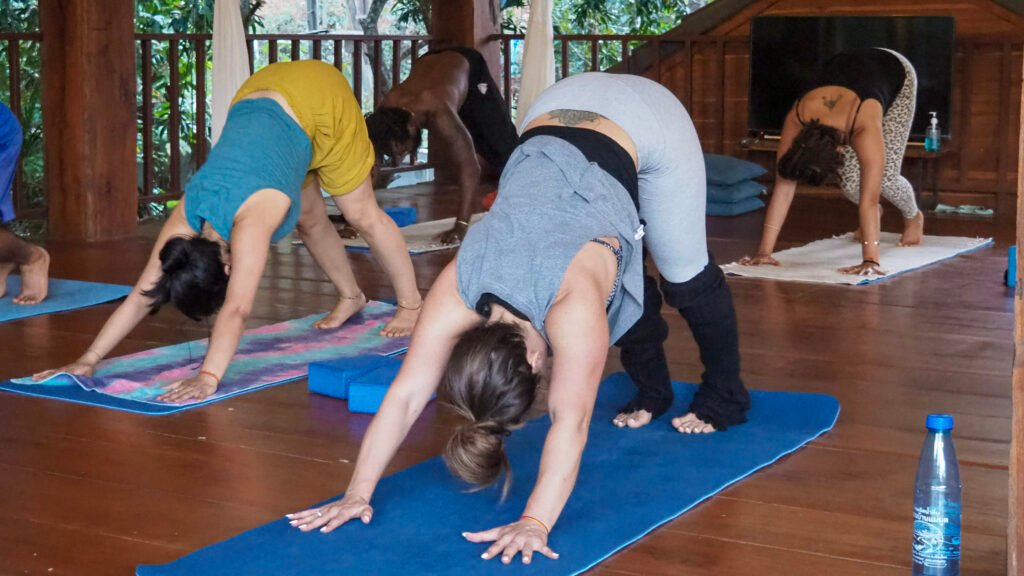
5. Downward-Facing Dog (Adho Mukha Svanasana)
Downward-Facing Dog is a weight-bearing pose that lengthens the back of the body. It can be demanding on the wrists or shoulders, so use the wall or a chair if needed.
How to practise
- Start on your hands and knees, with hands slightly ahead of your shoulders.
- Spread your fingers and press evenly through your palms.
- Tuck your toes and lift your knees, sending your hips up and back.
- Keep your knees bent as much as you need to lengthen your back.
- Let your head rest between your upper arms without forcing it down.
- Breathe comfortably for a few breaths, then lower your knees to the mat.
Easier option
Place your hands on a sturdy chair or wall and step back until your arms and back are long. Keep your feet planted and your knees soft.

6. Child’s Pose (Balasana)
Child’s Pose offers a quieter position between more active movements. The pose is optional, especially if kneeling or folding forward feels uncomfortable.
How to practise
- Begin on your hands and knees.
- Bring your big toes toward each other and widen your knees to a comfortable distance.
- Slowly move your hips toward your heels.
- Rest your hands forward on the mat or alongside your body.
- Let your head rest on a cushion or folded blanket if it does not comfortably reach the floor.
- Breathe easily, then use your hands to return to a seated or tabletop position.
Easier option
Place a folded blanket between your hips and heels, or stay upright on a chair and rest your hands on your thighs.
7. Reclined Figure-Four Stretch
This supine hip stretch may feel comfortable for some people after sitting. Keep the crossed foot flexed gently and do not pull the knee toward you.
How to practise
- Lie on your back with both knees bent and your feet on the floor.
- Cross your right ankle over your left thigh, just above the knee.
- Keep your right foot gently flexed.
- Stay here if you already feel a comfortable stretch around the outer hip.
- To increase the stretch slightly, lift your left foot and hold behind your left thigh.
- Keep your head and shoulders relaxed. Breathe normally, then lower your foot and uncross your legs.
- Repeat on the other side.
Easier option
Keep the supporting foot on the floor and avoid drawing the legs toward your chest.
8. Supine Spinal Twist
This gentle twist invites movement through the trunk. Keep both shoulders relaxed and use a smaller range if your back feels sensitive.
How to practise
- Lie on your back with your knees bent and feet on the floor.
- Open your arms out to the sides or rest them in a comfortable position.
- Keeping your knees together, let them move a small distance to the right.
- Turn your head only if it feels comfortable for your neck.
- Take a few easy breaths, then bring your knees back to the centre.
- Repeat on the left side.
Common mistake
Do not press your knees down with your hand or force your shoulders to stay on the floor. Let the movement remain gentle.
9. Supported Bridge Pose (Setu Bandha Sarvangasana)
Supported Bridge gently lifts the hips while the shoulders and feet remain grounded. Use a yoga block only if you already know how to place it safely. Otherwise, practise without a prop.
How to practise
- Lie on your back with your knees bent and your feet about hip-width apart.
- Place your feet flat on the floor, close enough that your fingertips can lightly reach your heels.
- Rest your arms alongside your body.
- Press through your feet and lift your hips a small amount.
- Keep your knees pointing forward and avoid turning them outward.
- Breathe comfortably, then lower your hips slowly.
- Rest before repeating if you wish.
Easier option
Keep your hips on the floor and gently rock your pelvis forward and back instead.

A Short Sequence After Sitting
You can try these poses in this order:
- Cat-Cow
- Standing Chest Opener
- Low Lunge on both sides
- Half Split on both sides
- Downward-Facing Dog or the chair-supported version
- Child’s Pose or a seated rest
- Reclined Figure-Four on both sides
- Supine Spinal Twist on both sides
- Supported Bridge
You do not have to do the full sequence every time. Choose a few poses that feel appropriate for your body and schedule. Use the transitions to pause and notice how you feel.
Small Movement Breaks During the Day
A yoga session after work can be one way to move, but it does not have to be the only movement in your day. When practical, stand up, walk briefly or change position between long periods of sitting. You can also try a gentle seated chest stretch or upper-body twist during a break.
Safety Notes
These poses are general movement suggestions, not a treatment for back pain or another medical condition. Yoga may need to be modified for people with injuries, health conditions, balance concerns or pregnancy. If you are unsure whether a pose is appropriate for you, ask a qualified health professional or yoga teacher.
If your back or hip pain is severe, persistent or worsening, seek advice from a qualified health professional rather than trying to stretch through it. You can also read our separate guide to yoga poses and back pain.

Frequently Asked Questions
Which yoga poses can I practise after sitting all day?
You can try gentle movements such as Cat-Cow, a supported Low Lunge, a mild hamstring stretch, a reclined Figure-Four and a comfortable twist. Choose the movements that suit your body and stop if they cause pain.
Should I stretch as deeply as possible?
No. A mild, comfortable stretch is enough. Forcing a deeper position can make it harder to relax and may cause discomfort.

Can I do these poses at my desk?
Cat-Cow, a chest opener and a gentle upper-body twist can be adapted for a stable chair. For floor poses, choose a safe space where you can get down and up comfortably.
How long should I hold each pose?
There is no single hold time that suits everyone. Try a few comfortable breaths, then move on or rest. Keep breathing normally rather than holding your breath.
Move Gently After a Long Day
These nine yoga poses offer simple ways to move your hips, back and upper body after sitting. Start with a comfortable range, use support when helpful and take breaks whenever you need them. A gentle practice should feel manageable, not forced.
Yoga Samaadhi Upcoming Events Sustainability Activity | Outreach Program | Yoga Teacher Training (Chiang Mai, Thailand)

Read Our Blog
Read our articles on different topics of yoga, sustainability and community updates…
More Details
Yoga TTC in Thailand
Learn about yoga teacher training and how it guides you to a harmonious lifestyle…
More Details
Community Outreach Programs
Find out more about hill tribes, their ways of life and how we can take part in their progress…
More Details
Sustainability Activity
Find spirituality in sustainability, living in harmony with nature and adopting mindfulness…
More Details