
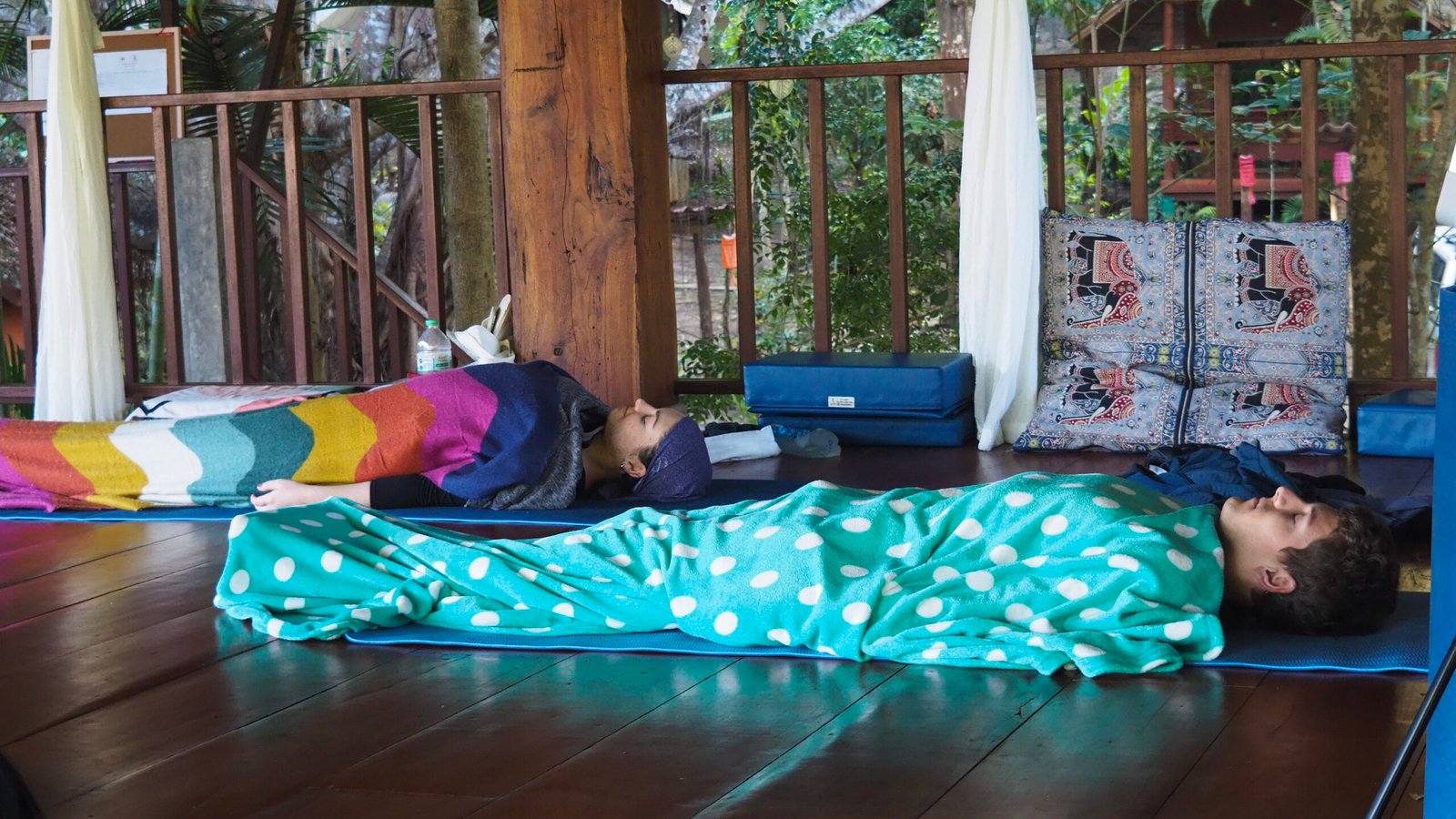
Yoga Nidra and meditation are closely related, which can make the terms confusing. Yoga Nidra is commonly taught as a guided meditation or relaxation practice, while meditation is a broad term for many ways of training attention and awareness.
A Yoga Nidra session often takes place lying down while a teacher guides your attention through different parts of the body, the breath or visualisation. Meditation can be practised in many positions and may use the breath, a sound, an image or another point of focus.
Neither practice requires you to stop every thought or reach a special state. The experience can differ from one person to another.
What Is Yoga Nidra?
Yoga Nidra is often translated as “yogic sleep.” In many modern classes, it refers to a guided practice done while lying down or resting in a supported position. A teacher or recording may guide you through relaxation, body awareness, breath awareness and, in some methods, visualisation or an intention.
Some people remain aware throughout a session. Others become drowsy or fall asleep. You do not need to achieve a particular state for the practice to count.
Yoga Nidra methods vary by teacher and tradition. Some sessions include a sankalpa, often described as a personal intention. Other sessions may not use one.
What Is Meditation?
Meditation is an umbrella term for practices that train attention, awareness or reflection. Some forms ask you to focus on the breath. Others use a repeated word, a sound, a visual object, a guided reflection or open awareness.
Meditation does not require you to make your mind completely blank. Thoughts may continue to appear. In many practices, you notice that your attention has wandered and gently bring it back to your chosen focus.
Meditation can be done sitting, lying down, standing or walking, depending on the method and what feels comfortable.
Yoga Nidra and Meditation: Similarities and Differences
Yoga Nidra
- What it is: A guided yoga-based relaxation or meditation practice.
- Common position: Usually practised lying down or in a supported resting position.
- Guidance: Often guided by a teacher or recording.
- Common focus: Body awareness, breath, sensations, visualisation or an intention.
- What to expect: You may feel relaxed, become drowsy or fall asleep.
Meditation
- What it is: A broad group of practices that train attention or awareness.
- Common position: May be practised sitting, lying down, standing or walking.
- Guidance: Can be guided or self-directed.
- Common focus: Breath, sound, words, an image, movement or open awareness.
- What to expect: You may feel focused, distracted, calm or restless.
The main difference is that Yoga Nidra is a specific guided practice, while meditation includes many different methods. The two can overlap, and the experience varies from person to person.
Possible Benefits and What to Expect
Some people use Yoga Nidra or meditation to make time for rest, reflect on their experience or practise attention. A session may feel calming, neutral, distracting or uncomfortable. There is no single correct response.
Research on Yoga Nidra is growing, but the studies use different methods and the quality of evidence varies. Current reviews suggest possible benefits for some wellbeing measures, but they do not establish Yoga Nidra as a guaranteed treatment for a health condition.
Meditation research also varies by practice and outcome. Neither Yoga Nidra nor meditation should replace prescribed care or professional help for ongoing mental or physical health concerns.
How to Try a Beginner Yoga Nidra Session
You can attend a guided class or use a recording from a teacher whose instructions feel comfortable to follow. You do not need to force yourself to stay awake or hold a particular position.
- Choose a comfortable place. Lie on a mat, bed or other stable surface. If lying flat is uncomfortable, rest on your side or use a reclined position.
- Support your body. Place a cushion under your head or knees, or use a blanket for warmth.
- Settle into the position. Let your arms and legs rest where they feel comfortable.
- Listen to the guidance. The teacher may invite you to notice sounds, the body, the breath or other sensations.
- Respond in your own way. You can follow the instructions, adjust your position or keep your eyes open if that feels better.
- Return gradually. At the end, notice the room around you and move slowly before standing.
If you fall asleep, that is a common experience. You can simply decide whether you want to rest or try another session at a time when you feel more alert.
How to Try a Simple Meditation
This short breath-awareness practice is one option. You can also choose a sound, a word or another comfortable point of attention.
- Sit in a chair or on a cushion, or choose another position you can maintain comfortably.
- Rest your hands and let your shoulders soften.
- Notice the natural movement of your breathing without trying to change it.
- When you notice that your attention has wandered, gently return it to the breath.
- Continue for a short time, then open your eyes or look around before moving on.
You do not need to stop thoughts from appearing. The practice is noticing where your attention has gone and choosing whether to return it to your focus.
For another beginner approach, read our guide to meditating every day without getting bored.
Which Practice Should You Choose?
You might prefer Yoga Nidra if you like being guided and resting in a supported position. You might prefer a seated meditation if you want to practise returning your attention to a simple focus. Some people use both at different times.
Choose according to what feels suitable, not because one practice is more advanced or more effective for everyone. If remaining still feels uncomfortable, a short walking meditation or gentle yoga movement may be a better fit.
If sleep is one of your goals, Yoga Nidra can be part of a relaxing routine for some people. It is not a guaranteed way to fall asleep or a treatment for insomnia. For more on yoga and sleep, see our article on yoga and better nights’ sleep.
Common Misunderstandings
“Meditation means stopping all thoughts”
Thoughts can continue during meditation. You can notice them and return your attention to the practice without judging yourself.
“Yoga Nidra means you must stay between sleep and waking”
Yoga Nidra is often described as a guided relaxation practice, and people experience it differently. Some remain aware, while others become drowsy or sleep.
“Yoga Nidra always includes a resolution or intention”
Some methods include a sankalpa or personal intention. It is not a required element in every session.
“A deeper experience means I am doing it correctly”
There is no need to experience bliss, unusual sensations or a particular state. A quiet or ordinary session is still a session.
“These practices cure stress or sleep problems”
Yoga Nidra and meditation may be supportive practices for some people, but they are not guaranteed treatments. Seek professional help if a health concern persists or affects your daily life.
Safety and Comfort
Choose a position that does not cause pain or numbness. You can move, open your eyes, pause the recording or stop at any time. You are not required to follow every instruction.
Meditation can feel uncomfortable for some people, including bringing up anxiety or difficult thoughts. If this happens, stop or switch to an external focus, such as listening to sounds in the room. Consider speaking with a qualified teacher or healthcare professional if the discomfort continues.
If you have a health condition or are unsure whether a practice is suitable for you, ask a healthcare professional for individual guidance.
Frequently Asked Questions
Is Yoga Nidra a form of meditation?
Yoga Nidra is commonly taught as a guided meditation or relaxation practice within yoga. Meditation is a broader category that includes many other methods.
Can I do Yoga Nidra sitting up?
Many sessions are practised lying down, but you can use a supported reclined or seated position if that is more comfortable. Follow the guidance while respecting your body.
Is Yoga Nidra the same as sleep?
No. Yoga Nidra is a guided practice, though some people become drowsy or fall asleep during it. The experience is not the same for everyone.
Which is easier for beginners?
Some beginners prefer Yoga Nidra because a teacher guides the session. Others prefer a short seated practice. You can try either one and decide what feels comfortable.
Can I practise both?
Yes. You can use different practices at different times. For example, you might try a short seated meditation during the day and a guided relaxation session when you want to rest.
Conclusion
Yoga Nidra and meditation overlap, but the terms describe different things. Yoga Nidra usually refers to a guided yoga-based relaxation practice, while meditation includes a wide range of ways to practise attention and awareness.
You do not need to stop your thoughts, remain perfectly still or reach a special state. Choose a comfortable method, adjust it when needed and let your own experience guide you.
Yoga Samaadhi Upcoming Events Sustainability Activity | Outreach Program | Yoga Teacher Training (Chiang Mai, Thailand)

Read Our Blog
Read our articles on different topics of yoga, sustainability and community updates…
More Details
Yoga TTC in Thailand
Learn about yoga teacher training and how it guides you to a harmonious lifestyle…
More Details
Community Outreach Programs
Find out more about hill tribes, their ways of life and how we can take part in their progress…
More Details
Sustainability Activity
Find spirituality in sustainability, living in harmony with nature and adopting mindfulness…
More Details