

After a long day at a desk or in a chair, you may want to move your hips, back and shoulders through a comfortable range of motion. A short yoga practice can give you a structured way to do that.
These nine yoga poses after sitting all day include gentle movement, hip stretches, a chest opener and supported floor poses. Move slowly and use the easier options whenever they feel more comfortable. The aim is to notice a mild stretch or comfortable movement, not to force your body into a deep pose.
Before You Begin
Choose a stable, non-slip surface with enough room to move. Wear comfortable clothing and keep a chair or wall nearby for support if you need it.
Start with a few gentle movements rather than trying to stretch as deeply as possible. Breathe normally. If a movement causes sharp pain, numbness, tingling or increasing discomfort, stop and return to a comfortable position.
1. Cat-Cow Pose (Marjaryasana-Bitilasana)
Cat-Cow gently moves the spine between a rounded and extended position. Keep the movement small and comfortable.
How to practise
- Come onto your hands and knees. Place your hands under your shoulders and your knees under your hips.
- Spread your fingers and let your head stay in line with your spine.
- As you breathe in, gently tip your sitting bones upward, move your chest forward and let your back form a soft arch.
- As you breathe out, press the floor away, round your back and let your head follow the movement without pulling your chin forcefully to your chest.
- Continue slowly for several comfortable rounds.
Easier option
If kneeling is uncomfortable, sit on a stable chair. Rest your hands on your thighs and gently alternate between lifting your chest and rounding your upper back.
2. Standing Chest Opener
A gentle chest opener can move your shoulders after a day of reaching toward a keyboard or screen. Keep the range of motion easy.
How to practise
- Stand with your feet about hip-width apart and your knees relaxed.
- Rest your hands on your hips, or gently bring your arms behind you and hold one wrist with the opposite hand.
- Draw your shoulders slightly back and down without forcing them.
- Lift through the centre of your chest while keeping your ribs relaxed.
- Stay for a few easy breaths, then release your arms.
Easier option
Keep your hands on your hips and simply widen across your collarbones. Do not pull your shoulders back hard.
3. Low Lunge (Anjaneyasana)
Low Lunge places one hip into extension while the other leg bends in front. You may feel a mild stretch at the front of the back hip. Use a folded blanket under your knee if needed.
How to practise
- Begin on your hands and knees, then step your right foot forward between your hands.
- Place your right knee above or slightly behind your ankle.
- Lower your left knee to the mat and untuck your toes.
- Place your hands on your right thigh or on yoga blocks for support.
- Gently move your hips forward until you notice a comfortable stretch at the front of your left hip.
- Keep your torso upright and breathe steadily. Avoid pushing your hips forward aggressively.
- Move back to hands and knees, then repeat on the other side.
Easier option
Keep both hands on a chair seat or blocks. If kneeling is uncomfortable, try a supported standing lunge with your hands resting on a wall or sturdy chair.
4. Half Split Pose (Ardha Hanumanasana)
Half Split provides a gentle stretch along the back of the front leg. You do not need to straighten your knee completely or fold deeply.
How to practise
- Begin in Low Lunge with your right foot forward and your left knee down.
- Shift your hips back until they are over your left knee.
- Straighten your right leg only as much as feels comfortable. Keep a soft bend in the knee if needed.
- Flex your right foot gently and place your hands on blocks or on the floor for balance.
- Lengthen your spine as you hinge slightly forward from your hips.
- Stay for a few comfortable breaths, then bend your front knee and return to Low Lunge.
- Repeat on the other side.
Common mistake
Avoid pulling your toes toward you forcefully or rounding your back to reach farther. A smaller stretch with a long spine is enough.
5. Downward-Facing Dog (Adho Mukha Svanasana)
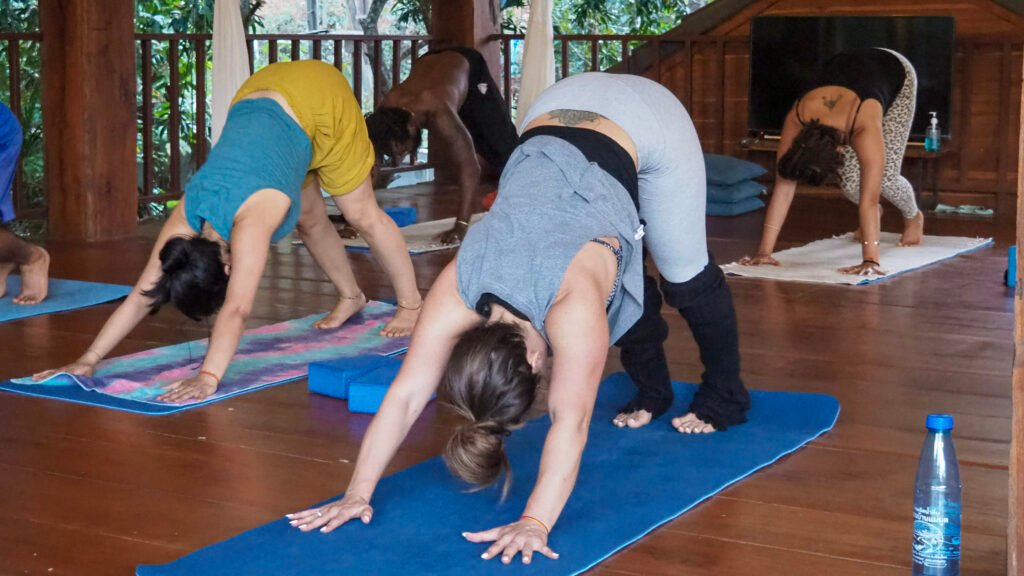
Downward-Facing Dog is a weight-bearing pose that lengthens the back of the body. It can be demanding on the wrists or shoulders, so use the wall or a chair if needed.
How to practise
- Start on your hands and knees, with hands slightly ahead of your shoulders.
- Spread your fingers and press evenly through your palms.
- Tuck your toes and lift your knees, sending your hips up and back.
- Keep your knees bent as much as you need to lengthen your back.
- Let your head rest between your upper arms without forcing it down.
- Breathe comfortably for a few breaths, then lower your knees to the mat.
Easier option
Place your hands on a sturdy chair or wall and step back until your arms and back are long. Keep your feet planted and your knees soft.

6. Child’s Pose (Balasana)
Child’s Pose offers a quieter position between more active movements. The pose is optional, especially if kneeling or folding forward feels uncomfortable.
How to practise
- Begin on your hands and knees.
- Bring your big toes toward each other and widen your knees to a comfortable distance.
- Slowly move your hips toward your heels.
- Rest your hands forward on the mat or alongside your body.
- Let your head rest on a cushion or folded blanket if it does not comfortably reach the floor.
- Breathe easily, then use your hands to return to a seated or tabletop position.
Easier option
Place a folded blanket between your hips and heels, or stay upright on a chair and rest your hands on your thighs.
7. Reclined Figure-Four Stretch
This supine hip stretch may feel comfortable for some people after sitting. Keep the crossed foot flexed gently and do not pull the knee toward you.
How to practise
- Lie on your back with both knees bent and your feet on the floor.
- Cross your right ankle over your left thigh, just above the knee.
- Keep your right foot gently flexed.
- Stay here if you already feel a comfortable stretch around the outer hip.
- To increase the stretch slightly, lift your left foot and hold behind your left thigh.
- Keep your head and shoulders relaxed. Breathe normally, then lower your foot and uncross your legs.
- Repeat on the other side.
Easier option
Keep the supporting foot on the floor and avoid drawing the legs toward your chest.
8. Supine Spinal Twist
This gentle twist invites movement through the trunk. Keep both shoulders relaxed and use a smaller range if your back feels sensitive.
How to practise
- Lie on your back with your knees bent and feet on the floor.
- Open your arms out to the sides or rest them in a comfortable position.
- Keeping your knees together, let them move a small distance to the right.
- Turn your head only if it feels comfortable for your neck.
- Take a few easy breaths, then bring your knees back to the centre.
- Repeat on the left side.
Common mistake
Do not press your knees down with your hand or force your shoulders to stay on the floor. Let the movement remain gentle.
9. Supported Bridge Pose (Setu Bandha Sarvangasana)
Supported Bridge gently lifts the hips while the shoulders and feet remain grounded. Use a yoga block only if you already know how to place it safely. Otherwise, practise without a prop.
How to practise
- Lie on your back with your knees bent and your feet about hip-width apart.
- Place your feet flat on the floor, close enough that your fingertips can lightly reach your heels.
- Rest your arms alongside your body.
- Press through your feet and lift your hips a small amount.
- Keep your knees pointing forward and avoid turning them outward.
- Breathe comfortably, then lower your hips slowly.
- Rest before repeating if you wish.
Easier option
Keep your hips on the floor and gently rock your pelvis forward and back instead.

A Short Sequence After Sitting
You can try these poses in this order:
- Cat-Cow
- Standing Chest Opener
- Low Lunge on both sides
- Half Split on both sides
- Downward-Facing Dog or the chair-supported version
- Child’s Pose or a seated rest
- Reclined Figure-Four on both sides
- Supine Spinal Twist on both sides
- Supported Bridge
You do not have to do the full sequence every time. Choose a few poses that feel appropriate for your body and schedule. Use the transitions to pause and notice how you feel.
Small Movement Breaks During the Day
A yoga session after work can be one way to move, but it does not have to be the only movement in your day. When practical, stand up, walk briefly or change position between long periods of sitting. You can also try a gentle seated chest stretch or upper-body twist during a break.
Safety Notes
These poses are general movement suggestions, not a treatment for back pain or another medical condition. Yoga may need to be modified for people with injuries, health conditions, balance concerns or pregnancy. If you are unsure whether a pose is appropriate for you, ask a qualified health professional or yoga teacher.
If your back or hip pain is severe, persistent or worsening, seek advice from a qualified health professional rather than trying to stretch through it. You can also read our separate guide to yoga poses and back pain.

Frequently Asked Questions
Which yoga poses can I practise after sitting all day?
You can try gentle movements such as Cat-Cow, a supported Low Lunge, a mild hamstring stretch, a reclined Figure-Four and a comfortable twist. Choose the movements that suit your body and stop if they cause pain.
Should I stretch as deeply as possible?
No. A mild, comfortable stretch is enough. Forcing a deeper position can make it harder to relax and may cause discomfort.

Can I do these poses at my desk?
Cat-Cow, a chest opener and a gentle upper-body twist can be adapted for a stable chair. For floor poses, choose a safe space where you can get down and up comfortably.
How long should I hold each pose?
There is no single hold time that suits everyone. Try a few comfortable breaths, then move on or rest. Keep breathing normally rather than holding your breath.
Move Gently After a Long Day
These nine yoga poses offer simple ways to move your hips, back and upper body after sitting. Start with a comfortable range, use support when helpful and take breaks whenever you need them. A gentle practice should feel manageable, not forced.
Yoga Samaadhi Upcoming Events Sustainability Activity | Outreach Program | Yoga Teacher Training (Chiang Mai, Thailand)

Read Our Blog
Read our articles on different topics of yoga, sustainability and community updates…
More Details
Yoga TTC in Thailand
Learn about yoga teacher training and how it guides you to a harmonious lifestyle…
More Details
Community Outreach Programs
Find out more about hill tribes, their ways of life and how we can take part in their progress…
More Details
Sustainability Activity
Find spirituality in sustainability, living in harmony with nature and adopting mindfulness…
More Details